





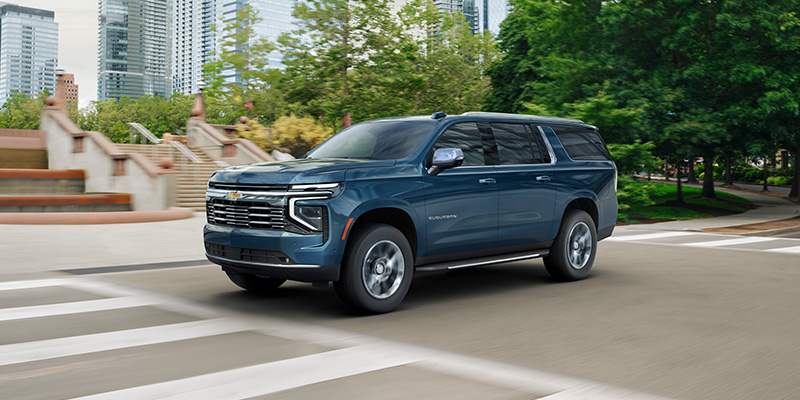
If you’re shopping for a large Chevy SUV and trying to decide between two of the brand’s most iconic nameplates, you’ve landed in the right place. This Chevy Tahoe vs Chevy Suburban comparison breaks down the key differences, so you can make an informed decision before visiting the lot.
Both models share the same platform, the same available powertrains, and the same reputation for capability — but they aren’t identical. Knowing where they differ can save you time and help you match the right vehicle to your lifestyle.
Size and Interior Space
When it comes to which full-size SUV has more space and towing capability, the Suburban holds a clear advantage on the space side. The Suburban is noticeably longer than the Tahoe, and that extra length translates directly into more third-row legroom and significantly more cargo volume with a best in class 144.5 cu ft max cargo volume.
The Tahoe is no slouch when it comes to passenger room, and it has a max cargo volume of 122.7 cu ft with the rear seats folded down, but families who routinely carry 7 or 8 passengers as well as luggage will feel the difference. If you’re frequently loading up for road trips or hauling gear for a large family, the Suburban’s extra cargo room may be the deciding factor.
Towing and Capability
Both the 2026 Tahoe and 2026 Suburban are serious tow vehicles when properly equipped. Both are available with a 5.3L V8 or a 6.2L V8 engine, and both offer similar maximum towing ratings (8,400 lbs for the Tahoe, 8,300 lbs for the Suburban) when configured comparably.
So, if you’re towing a boat, a horse trailer, or a camper, either SUV is built for the job. The question of which full-size SUV has more space and towing muscle comes down to how you plan to use it — the Suburban’s additional length doesn’t greatly reduce its towing capacity, which makes it an especially compelling choice for buyers who want space and towing capacity.
Maneuverability and Daily Driving
The Tahoe’s shorter overall length makes it noticeably easier to maneuver in parking garages, city streets, and tighter driveways. If you’re primarily using your SUV for school runs, errands, and daily commutes, the Tahoe’s more compact footprint can be a benefit.
The Suburban, while still drivable in most settings, is best suited to drivers who prioritize passenger and cargo capacity and aren’t deterred by its larger dimensions. Both models benefit from available camera systems and parking aids that help manage their size on the road.
Features and Technology
In a Chevy Tahoe vs Chevy Suburban comparison, the feature sets are largely identical across equivalent trim levels. Both are available with available Super Cruise® — Chevy’s hands-free driving technology — along with a large touchscreen, available rear-seat entertainment, wireless charging, and a built-in hotspot.
Available safety features, driver assistance technology, and comfort amenities are consistent across both models at each trim level. So, if technology is your primary focus, you won’t need to choose one over the other based on features alone.
Which One Is Right for Your Family?
For most buyers, the choice comes down to how much space you truly need. The Tahoe is a well-rounded, capable, and slightly easier-to-drive option that still delivers impressive room and towing capability. The Suburban is the better choice when maximum passenger comfort and cargo space are non-negotiable priorities.
Stop by Bale Chevrolet in Little Rock, AR
If you’re still weighing the Chevy Tahoe vs Chevy Suburban comparison after reading this, the best next step is to see both vehicles in person. Sitting in the third row, loading cargo, and taking a test drive will quickly clarify which model fits your day-to-day life. Stop by Bale Chevrolet, serving drivers throughout Little Rock, Arkansas, and let the team help you find the right full-size SUV for your family’s needs.
Connect with us


